martes, marzo 04, 2025

Affliction and the Mystery of Self-Emptying. From Simone Weil to the Cross of Christ.


Israel Centeno

Affliction, sorrow, and tribulation — these are not mere synonyms but profound realities that define human existence in its relationship with the world and the Divine. Simone Weil understood affliction (malheur) as something distinct from ordinary suffering. It is a state so overwhelming, so absolute, that it alienates the soul, rendering it incapable of love, of giving or receiving grace. It is the extremity of human suffering, where pain ceases to be a passage and becomes an abyss, an exile from meaning itself.

But how does one transcend this state? How does affliction, which seems to annihilate the soul, become the means of its salvation? This is a mystery, a mystery unveiled in the God who emptied Himself (kenosis), in the One who relinquished all power, even the power of His own presence, and endured the extremity of suffering in innocence, humiliation, and death. The Passion of Christ, His torment and crucifixion, is the key to understanding how affliction is not the final word but the path to the ultimate victory.

The Mystery of Kenosis: Self-Emptying and the Cross

Saint Paul, in his Letter to the Philippians (2:7), proclaims that Christ “emptied Himself, taking the form of a servant, being made in the likeness of men.” This kenosis — the divine self-emptying — is at the heart of the Christian mystery. It is not merely an act of condescension but a radical renunciation: Christ does not merely become human; He surrenders everything, even His own divine prerogatives, to fully inhabit the condition of fallen man.

The first self-emptying is the Incarnation: God becomes man, embracing weakness, smallness, and contingency. The Word dwells among us for thirty years, not revealing His divine nature, not wielding His omnipotence. Then, in the Garden of Gethsemane, He faces the second kenosis: the agony before the Passion. He falls to the ground, sweating blood, trembling. Fear and desolation consume Him. And yet, in the depth of this affliction, He submits to the will of the Father.

Finally, on the Cross, comes the ultimate self-emptying. Christ endures not only physical agony but utter humiliation, the stripping away of all dignity. And then, the cry that echoes through history:

“My God, My God, why have You forsaken Me?”

Here, Christ enters into the absolute affliction that Simone Weil describes — the moment where there is no consolation, no reprieve, where even God seems absent. It is the suffering that Ivan Karamazov finds unbearable, the suffering of innocent children, the unredeemed pain that challenges faith itself. And yet, in this abandonment, Christ does not recoil. He remains. He inhabits affliction fully, and by doing so, He transfigures it.

Entropy, Corruption, and the Resurrection of the Flesh

This mystery is not only inscribed in human suffering but in the very fabric of the universe. The truth of affliction is visible in the law of entropy, in the death of stars and planetary systems, in the dissolution of all that is contingent, all that will inevitably pass away. Even our thoughts — our relentless pursuit of comprehension — are bound to the limits of decay, to a universe that expands from the primordial fire of the Big Bang only to dissolve into cold silence.

And yet, it is precisely in this destruction that redemption is unveiled. The same dissolution that consumes creation also participates in the renewal of all things. Everything that has the breath of God — the Spirit that animates life — yearns for this redemption. This is the moment Christ embodies at the height of His Passion, when He breathes out His final words:

“Father, into Your hands I commend My Spirit.”

This is not merely resignation; it is an act of ultimate trust. Christ, fully emptied, entrusts His very breath, His soul, His spirit to the Father. And in doing so, He does not fall into nothingness — He transfigures all that perishes into the seed of what will be eternally redeemed.

Thus, the corruptibility of the flesh — the decay of all living things — is not the final destiny of creation. Memento mori, the ancient reminder of death, is not the end of the story. The very corruption of the body, which affliction makes undeniable, is answered by the promise of bodily resurrection.

Saint Paul affirms in 1 Corinthians 15:42–44:

“So also is the resurrection of the dead. It is sown in corruption; it is raised in incorruption. It is sown in dishonor; it is raised in glory. It is sown in weakness; it is raised in power. It is sown a natural body; it is raised a spiritual body.”

The body that decays, the flesh that suffers affliction, is not discarded in eternity. It is transfigured. Christ’s Resurrection is not a mere metaphor — it is the definitive answer to the entropy of creation, to the corruption of the flesh, to the suffering that afflicts all living things.

Attention and Contemplation: From Affliction to Supreme Beauty

Simone Weil speaks of attention as the highest form of prayer, a path not merely to knowledge but to the direct apprehension of truth. True attention enables us to contemplate, in human suffering and the sacrifice of the innocent, the mysteries of the cosmos itself.

Standing before a depiction of the Passion, such as Velázquez’s Christ Crucified or the most dramatic of all, Grünewald’s Crucifixion, we do not see mere torment — we see order, proportion, harmony. The wounds of Christ are not random desecrations; they are part of a deeper architecture, the perfect symmetry of sacrifice.

This is not a superficial aesthetic harmony but the same harmony that governs the universe: the fine-tuned physical constants that sustain creation, the mathematical elegance underlying nature’s laws, the golden ratio inscribed in the forms of life, the perfect balance in every self-regulating system of existence.

The visible world is structured by a hidden geometry, an unseen harmony. And if such a harmony governs the created order, how much greater must it be in the invisible realm?

Transcending Affliction: Passing Through the Veil

At the moment of Christ’s death, the veil of the Temple is torn in two. The barrier between God and man is destroyed. On the Cross, Christ endures the most radical abandonment, and yet that abandonment becomes the gateway to divine fullness.

Thus, Saint Paul can boldly proclaim:

“O death, where is your sting?”

The greatest affliction, the most absolute suffering, is not the end. Suffering does not have the final word. But to transcend it, we must pass through the veil. We must enter into the mystery of Christ’s suffering with attention and contemplation, as Weil instructs.

For true happiness is not the mere absence of pain but a state of grace, a realm where affliction has been transfigured into love — into a love no longer bound by necessity or the gravitational weight of the world.

A love that conquers death.

A love that raises even what has perished into incorruptible glory.

lunes, marzo 03, 2025

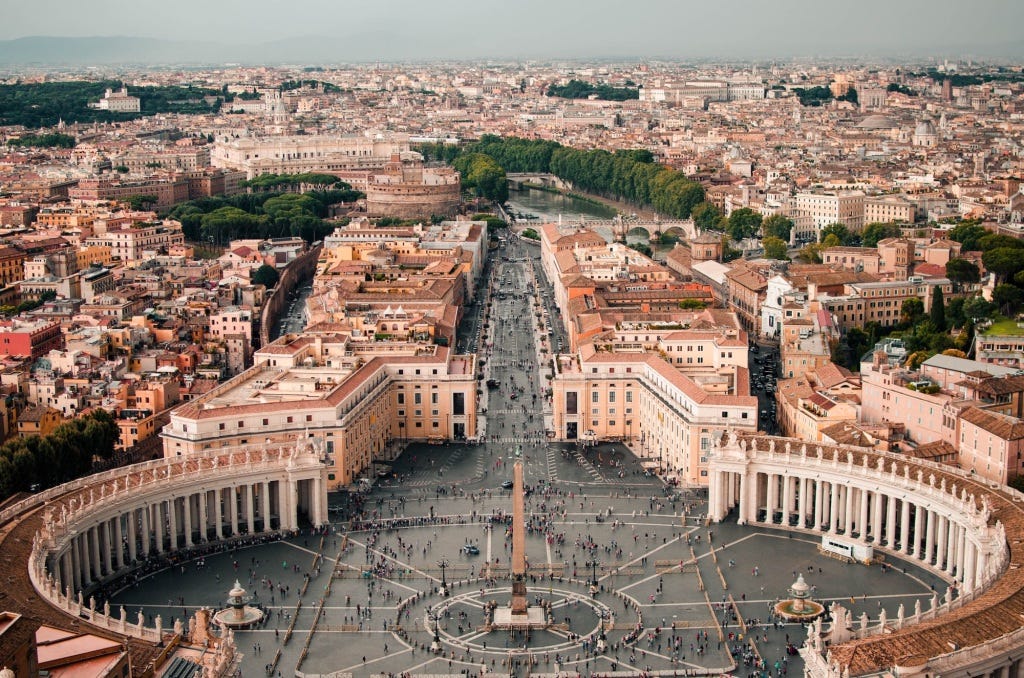
The Wealth of the Vatican: Beyond Myths and Misconceptions


March 3, 2025


Israel Centeno

One of the most persistent criticisms of the Catholic Church is its supposed vast wealth. Many ask, why doesn’t the Vatican sell everything and distribute it to the poor? On the surface, the idea may seem logical — after all, the Vatican houses priceless artworks, magnificent cathedrals, and cardinals who wear elaborate vestments. But this criticism stems from a superficial understanding of what the Church’s “wealth” actually consists of and how it operates globally.

The Vatican’s Art and Heritage: A Treasury for Humanity, Not a Fortune

When people speak of the Vatican’s riches, they often think of Michelangelo’s Sistine Chapel, Bernini’s sculptures, or Raphael’s frescoes. However, these masterpieces are not financial assets that can be liquidated at will. They are not owned in the same way a corporation owns its assets. Rather, they belong to humanity and are preserved as part of the Church’s mission to safeguard cultural and spiritual heritage.

Selling these works of art would not only be impractical but also counterproductive. Who would buy the Pietà or the Sistine Chapel? Would they end up in private collections, inaccessible to the public? The Vatican acts as a guardian of these treasures, ensuring they remain available to people from all over the world. Expecting the Church to sell its artistic heritage to finance short-term relief efforts is as misguided as demanding that museums sell their entire collections to fund social programs.

Moreover, the construction of grand cathedrals and churches throughout history was never intended as an expression of luxury but as a reflection of divine beauty and a space for worship. The goal was not to amass wealth but to create sacred spaces that elevate the human spirit.

The Real Investment: The Church’s Humanitarian Work

Beyond its artistic and architectural legacy, the Church’s true wealth lies in its global presence among the poorest and most vulnerable. Across the world, Catholic organizations run schools, hospitals, orphanages, and shelters.

A clear example is Fe y Alegría, an initiative that has provided education in impoverished areas of Latin America, including Venezuela, where it has reached communities that neither government agencies nor private institutions have cared for. In many cases, Catholic priests and religious orders are the only ones bringing education and opportunity to those in desperate situations.

This is a reality that repeats itself worldwide: in slums, war zones, and remote areas, Catholic missionaries, religious orders, and laypeople are actively working to support those in need. The Church doesn’t just provide immediate aid but also long-term solutions — building schools, creating rehabilitation programs, assisting prisoners, and offering higher education opportunities to break cycles of poverty.

The Social Doctrine of the Church: A Commitment to the Poor

The Church is not just a charitable institution; it has a structured social doctrine that informs its commitment to justice, human dignity, and economic ethics. While the Vatican does manage funds — just like any state must — it channels much of its resources into humanitarian and educational projects.

It is also important to acknowledge that, like any institution, the Church has had corrupt individuals in its history. Some popes and clergy members have succumbed to greed, but these are exceptions. For every corrupt figure, there are hundreds of St. Francises, thousands of Mother Teresas, and countless unnamed priests, nuns, and laypeople working tirelessly to care for the abandoned, the sick, and the persecuted.

The Forgotten Sacrifice: Martyrs of the Church

One aspect rarely acknowledged by critics is the cost of this humanitarian work. Many priests, nuns, and Catholic volunteers have been killed in conflict zones, persecuted for their faith, or imprisoned for helping the vulnerable. In places like the Congo, Nigeria, and the Middle East, Church workers risk their lives to aid the suffering.

The Church does not ask about political affiliations, religious beliefs, or backgrounds before offering assistance. It simply helps because that is the radical love Christ calls for — an unconditional love that is lived out daily in missions, hospitals, and refugee camps.

Beyond Superficial Criticism

The accusation that the Vatican hoards wealth while ignoring the suffering of the world does not hold up to serious scrutiny. The Church is not a multinational corporation amassing profits; it is a global institution dedicated to faith, charity, and education. While it maintains a small independent state (the Vatican), it uses its resources to sustain a mission that reaches the most neglected areas of the world.

The real question should not be why doesn’t the Church sell its treasures? but rather why do so many critics ignore the immense work the Church does for the poor? While some focus on the external appearance of bishops’ robes or the splendor of cathedrals, they overlook the countless Catholic-run hospitals, orphanages, schools, and shelters that provide hope and dignity to millions.

The true wealth of the Church is not in its art or vestments but in its unwavering commitment to serving the least among us — a mission it has carried forward for over two thousand years.

It Is Simplistic to Say Otherwise

It is overly simplistic to claim that the Vatican could solve global poverty by liquidating its assets. This argument relies on a misunderstanding of what the Church’s “wealth” actually consists of, how its resources are used, and the nature of economic realities.

1. The Vatican’s Assets Are Not Liquid

The Church’s artistic and architectural treasures are not stockpiles of cash that can be easily distributed. Selling the Sistine Chapel or St. Peter’s Basilica would not only be logistically impossible but also futile — such works belong to humanity, not to a private entity. If sold, they would likely end up in the hands of private collectors rather than serving any meaningful social cause.

2. One-Time Charity Does Not Solve Poverty

Even if the Vatican were to auction off its treasures, the proceeds would be a temporary fix, not a structural solution. The underlying causes of poverty — lack of education, systemic corruption, broken institutions — would remain. The Church, through its schools, hospitals, and charities, focuses on long-term assistance, which actually helps people escape poverty rather than offering short-lived relief.

3. The Church’s Global Charitable Network Already Operates on a Massive Scale

The Catholic Church is one of the world’s largest providers of healthcare and education, often in areas where governments have failed. Organizations like Fe y Alegría in Latin America, Catholic Relief Services, and countless missionary initiatives offer direct aid to the most vulnerable. The Church is already redistributing resources, just not in the simplistic way critics demand.

4. The Vatican Functions as a Sovereign State

Like any government, the Vatican requires operational funds to maintain diplomatic relations, security, and administration. Expecting it to function without resources would be like asking a nation to dissolve itself while still carrying out its responsibilities.

The real issue is not about selling art or vestments but about ensuring that resources are used effectively for long-term humanitarian impact. The Catholic Church, despite its flaws, has done more to alleviate suffering than most institutions in history, not through short-sighted wealth redistribution, but through sustained efforts in education, healthcare, and social justice.

The Vatican and the Fascination with Mystery: Between Myth and Reality

Beyond its artistic and humanitarian legacy, the Vatican is often at the center of speculation, myths, and conspiracy theories. People are naturally drawn to secrecy, and the idea that the Church — one of the oldest institutions in the world — holds hidden truths only adds fuel to the fire. If you want to write a bestselling novel, one of the surest ways is to weave a story about Vatican mysteries: secret conclaves, forbidden documents in the Vatican Archives, or even the murder of a poet entangled in dark, ecclesiastical intrigue.

This fascination is not just about religion; it is about the allure of what seems untouchable. Governments, corporations, and intelligence agencies all have secrets, but few inspire the same sense of awe and curiosity as the Vatican. The Church, with its long history, rich traditions, and global influence, is a perfect breeding ground for both genuine historical intrigue and wild speculation.

From Dan Brown’s Angels & Demons to old theories about suppressed gospels and hidden relics, the idea that the Vatican controls knowledge that could “change the world” persists in popular culture. Many people assume that behind the grand walls of St. Peter’s Basilica, there must be truths too powerful for the world to handle.

The reality, however, is less sensational but far more compelling. The Vatican is not a monolithic entity hiding supernatural secrets; it is an institution composed of humans — brilliant, flawed, devoted, and sometimes corrupt. It has endured wars, schisms, and crises, not because of secret knowledge, but because of its deep theological foundation and its role in guiding billions of believers.

Even the real Vatican mysteries — like unsolved deaths, internal power struggles, and the complexities of conclaves — are not unlike those found in any institution of significant power. The difference is that, because of the Vatican’s religious significance, these stories carry an added weight, an almost mythological aura.

Why the World Seeks Mysteries in the Church

The desire to uncover Vatican secrets often reflects a deeper spiritual or existential longing. If the Church were simply an outdated institution with no relevance, it wouldn’t attract so much scrutiny. The persistence of these conspiracies suggests that, even among skeptics, there is an acknowledgment — conscious or not — that the Church matters.

It is easier for some to believe that the Vatican is hiding world-shattering truths than to engage with what the Church actually teaches. A hidden gospel that “contradicts everything” is more thrilling than the challenge of living a moral and spiritual life. The idea of a pope secretly controlling world affairs is more exciting than the reality of a pope struggling with the same geopolitical tensions and humanitarian crises as other world leaders.

Myth vs. Mission: The True Riches of the Church

This constant fascination with Vatican conspiracies often overshadows the real work of the Church. While some imagine underground vaults filled with hidden knowledge, the Church is actually present in places of immense suffering — war zones, famine-stricken regions, and impoverished communities.

While conspiracy theorists speculate about secret conclaves, Catholic missionaries are in the trenches, teaching, healing, and serving those the world has forgotten. This is the true “secret” of the Church: not hidden wealth, not dark knowledge, but an unbroken mission of love and sacrifice.

So, if one were to write a novel about Vatican mysteries, the real intrigue would not be in some imagined hidden manuscript, but in the reality of how the Church has survived centuries of turmoil. The true mystery is not what the Vatican hides but what has allowed it to endure: a faith that continues, against all odds, to shape history.

Beyond Superficial Criticism

The accusation that the Vatican hoards wealth while ignoring the suffering of the world does not hold up to serious scrutiny. The Church is not a multinational corporation amassing profits; it is a global institution dedicated to faith, charity, and education. While it maintains a small independent state (the Vatican), it uses its resources to sustain a mission that reaches the most neglected areas of the world.

The real question should not be why doesn’t the Church sell its treasures? but rather why do so many critics ignore the immense work the Church does for the poor? While some focus on the external appearance of bishops’ robes or the splendor of cathedrals, they overlook the countless Catholic-run hospitals, orphanages, schools, and shelters providing millions hope and dignity.

The true wealth of the Church is not in its art or vestments but in its unwavering commitment to serving the least among us — a mission it has carried forward for over two thousand years.

domingo, marzo 02, 2025

The Tunnel. A Flawless Thriller and a Sharp Portrait of Europe


Israel Centeno

Gripping, intense, and superbly written, The Tunnel is a series that leaves no loose ends. This British-French remake of the acclaimed Bron/Broen—the Swedish-Danish production that redefined Nordic noir—retains its own identity while staying true to the essence of the original. Its script is impeccably crafted, with well-drawn characters and an atmosphere that captures a world in transit, a postmodern world on the brink of collapse.

From the outset, the series presents a compelling premise: a murder in the Channel Tunnel, right on the border between France and the United Kingdom, forces two radically different detectives to work together. Karl Roebuck, the British detective played by Stephen Dillane, is the epitome of irreverent charm—a family man with a chaotic and transgressive approach to both life and the job. His French counterpart, Elise Wassermann, portrayed brilliantly by Clémence Poésy, is an exceptionally intelligent but socially awkward detective, whose way of interacting with the world suggests that she is on the autism spectrum.

The relationship between these two characters is the true heart of The Tunnel. Their dynamic not only reflects the linguistic and cultural barriers between the British and the French but also encapsulates the broader challenges of human communication. Elise, utterly incapable of lying and obsessively analytical, is an immovable force. Karl, with his sarcasm and pragmatism, is a man constantly in motion. The contrast is fascinating, and over time, their relationship evolves from mutual distrust to a profound and touching partnership.

One of The Tunnel’s greatest achievements is Elise’s character development. Her personal history—marked by the childhood death of her twin sister—adds a layer of vulnerability to her outward coldness. In the first season, her interactions with others seem almost robotic, yet as the series progresses, it becomes clear that her inability to express emotions does not mean she lacks them. Her tenderness towards Karl’s son, her genuine concern for his family, and the quiet bonds she forms with her colleagues reveal that Elise is far from indifferent—she is deeply compassionate.

Beyond her professional relationships, Elise also surprises with her ability to sustain a romantic relationship. What begins as a one-night stand with a hotel bartender unexpectedly develops into a long-term connection that endures across seasons. At first, no one would believe such a relationship could last, yet it does. Elise, despite her struggles with emotional connection, demonstrates genuine care for her partner, feeling anxiety when he is arrested and standing by him with a steadfast sense of justice. This subplot is handled with the same level of detail and authenticity as the rest of the series, reinforcing her character’s complexity.

Yet The Tunnel is more than just a character study. It is a masterfully executed thriller that tackles some of the most pressing issues in contemporary Europe: terrorism, human trafficking, labour exploitation, corruption, and ideological radicalisation. Beneath these themes, there is also an implicit but undeniable thread concerning migration and demographic shifts. While the series does not address these issues head-on, they are present in the way characters navigate between two worlds, in the conflicts that arise along borders, and in the broader sense of Europe as a place in constant transformation.

Despite its modern setting, The Tunnel also allows for connections to Europe’s past, particularly through Karl’s character. As the son of a communist, Karl represents a generation that grew up in the ideological struggles of the Cold War, rebelling against his father by becoming a police officer. This generational tension is echoed in his own relationship with his eldest son, who, in a radically different context, also finds himself at odds with his father. The series thus traces an arc from the political struggles of the 20th century to the dilemmas faced by Millennials and Generation Z, showing how history repeats itself in new forms.

Visually, The Tunnel is stunning. The series shifts between the cold, muted tones of Calais and the misty Kent coastline, creating a contrast that reinforces its theme of blurred borders. The cinematography is imbued with a melancholic tension, perfectly complementing a narrative that teeters between despair and redemption.

But beyond its excellence as a thriller, The Tunnel dares to present a character who may, in some ways, foreshadow the future of humanity. Elise is not just a product of her time—she embodies a growing trend in modern society. Statistics suggest an increasing number of people experience social difficulties or are identified as being on the autism spectrum. What was once rare is now common. Elise, with her relentless logic, emotional detachment, and unyielding moral code, could well be a glimpse of the human being to come—a vision of a future where traditional modes of social interaction give way to a different kind of intelligence, one shaped by structure, rationality, and an alternative approach to empathy.

Ultimately, The Tunnel is a work of the highest calibre, both in its technical execution and thematic depth. It functions as a first-rate thriller, a psychological drama, and a sharp critique of contemporary Europe. Its story captivates, its characters fascinate, and its reflection of reality unsettles. For those seeking a series that seamlessly blends intelligence, emotion, and gripping suspense, The Tunnel is an impeccable choice.

With the Congo, an Invisible Conflict in a World That Chooses Its Tragedies


Israel Centeno

The world tears its garments over conflicts that the media and global elites choose to highlight. Meanwhile, the Congo continues to bleed in silence. There are no massive protests in the West, no emergency conferences in international organizations, no viral outrage on social media. The war in the Democratic Republic of the Congo is the war no one wants to see.

Why? Because it doesn’t fit the narrative that the media and powerful nations have built about which lives matter and which tragedies should be told. There is no easily identifiable enemy, no convenient propaganda. There is only death, exploitation, displacement, and oblivion. And in the meantime, we keep consuming phones, batteries, and technology powered by minerals extracted with the blood of enslaved children.


1. The Silenced War

More than six million people have died in the Congo since the conflict began in the 1990s. It is the deadliest war since World War II. However, its media coverage is practically nonexistent compared to other conflicts that receive constant attention.

The armed groups operating in the Congo finance themselves through illegal mining, trafficking minerals like coltan and cobalt, and controlling strategic routes. Major tech corporations, directly or indirectly, profit from this plunder, while governments and international organizations look the other way.

If the Congo had a strategic geopolitical position or if its narrative were convenient for certain interests, its tragedy would dominate the headlines. But because its suffering doesn’t fit a clear media agenda, the world prefers to ignore it.


2. The Hypocrisy of Selective Outrage

Every year, we see how some conflicts are amplified by the media with an intensity that dictates the world’s reaction. The United Nations, the European Union, the United States, and other powers respond with sanctions, resolutions, and condemnations. Charity concerts are organized, funds are raised, awareness campaigns are launched.

But when it comes to the Congo, there is only uncomfortable silence. Where are the emergency resolutions from the Security Council? Where are the calls to action from global celebrities and activists? Where are the peace conferences that make headlines for weeks?

The answer is clear: the suffering of the Congo is not profitable for the international narrative. It cannot be easily instrumentalized to justify military interventions, regime changes, or economic pressures. It is a war of resources, exploitation, and systemic corruption, and those who profit from it are too entangled with the very interests that control global information.


NYT2008121011495100C

3. Persecuted Christians, Raped Women, Enslaved Children

Christians in the Congo face a double threat: religious persecution and the world’s indifference. Extremist groups and local militias have massacred entire Christian communities, burned churches, and kidnapped priests and nuns. But this, too, does not fit the media’s agenda.

Meanwhile, thousands of women have been victims of sexual violence used as a weapon of war, and children as young as six years old are forced to work in mines under inhumane conditions. All these horrors continue with the complicity of those who prefer not to talk about the Congo—because doing so would mean questioning how the modern world acquires its technological wealth.


4. Who Will Speak for the Congo?

We can no longer ignore this invisible war. We cannot allow tragedies to be selected and prioritized according to the interests of the powerful.

The world needs to wake up to the reality that the Congo is part of our daily lives: in our phones, our computers, our electric cars. Indifference is not an option when our consumer choices and passivity contribute to the suffering of millions.

The Congo is screaming amid global silence. The question is: will we continue not to listen?

Here is the translated version of your text:


The War No One Wants to See and the Technology That Fuels Exploitation

While the world obsesses over technological advancements and the latest generation of electronic devices, a silent war continues to devastate the Democratic Republic of the Congo (DRC). This conflict, which has claimed millions of lives, remains in the shadows of international indifference, despite being fueled by the very progress that the West celebrates.

At the heart of this tragedy is the extraction of strategic minerals such as coltan, cobalt, and other resources essential for manufacturing smartphones, electric batteries, and electronic components. However, few question who pays the price for this modernity: children enslaved in mines, women subjected to brutal violence, men forced to work in inhumane conditions, and Christian communities persecuted in a conflict that blends economic ambition, geopolitical interests, and a disregard for human life.


1. A Forgotten but Unresolved Conflict

The DRC is one of the richest regions in natural resources, yet also one of the poorest and most violent in the world. Since the 1990s, the country has been trapped in an endless war, driven by competition among armed groups, foreign interventions, and the greed of corporations that rely on its minerals.

Human rights organizations have documented the systematic use of child labor in the mines of eastern Congo, where children as young as six years old work long hours extracting minerals under hazardous conditions. Women and girls fall victim to sexual violence used as a weapon of war, while Christian communities are persecuted by armed groups seeking control of territories and resources.

Despite the evidence, the international community continues to look the other way. Economic interests outweigh principles, and exploitation persists without real consequences for those who profit from it.


2. Technology and the Blood of the Innocent

Every time someone buys a new phone or an electric car, it is likely that some of its components contain minerals extracted in the Congo under inhumane conditions. Tech companies have been accused of relying on supply chains that, directly or indirectly, finance exploitation and violence in the region.

Coltan, for example, is a crucial mineral for manufacturing capacitors in electronic devices. Its extraction is largely controlled by armed groups that impose forced labor conditions and use violence to maintain control over the mines. The same happens with cobalt, essential for lithium-ion batteries used in phones, computers, and electric vehicles.

Despite commitments from some companies to audit their supply chains, the reality is that a large portion of these minerals still reach the international market without ethical guarantees. As demand grows, so does the exploitation of the most vulnerable.


3. Persecution of Christians in the Congo

Amidst the chaos, Christians in the Congo face a double threat: on one hand, the violence of armed groups attacking them for their faith; on the other, the indifference of an international community that fails to recognize the magnitude of their suffering.

Organizations such as Open Doors have reported systematic attacks on Christian communities, including murders, church burnings, and kidnappings. The presence of extremist groups in the region has exacerbated the persecution, while local militias seek territorial control, displacing and massacring entire populations.

Many Christians in the DRC live in a constant struggle for survival, without access to protection or justice. Their suffering is yet another invisible cost of a war the world prefers not to see.


4. Is There Hope?

Despite the tragedy, there are those who continue to resist. Christian leaders in the region work tirelessly to assist victims, expose violence, and keep faith alive amidst despair. The Church has been a refuge for thousands of displaced people, offering humanitarian aid and hope in a country where justice seems unattainable.

However, change cannot depend solely on those who suffer. It is the responsibility of the international community to demand greater transparency in mineral supply chains, ensure that tech companies do not indirectly finance exploitation, and pressure governments to take effective action against violence in the Congo.

It is easy to ignore what happens thousands of miles away, but the reality is that our consumer choices can make the difference between perpetuating suffering or promoting change.

The Congo continues to bleed. The question is: will we keep ignoring it?

sábado, marzo 01, 2025

Dostoyevsky and Simone Weil: A Response to the Problem of Evil


Dostoyevsky and Simone Weil: A Response to the Problem of Evil


Israel Centeno

The problem of evil remains the most visceral challenge to belief in God. Ivan Karamazov’s rebellion in The Brothers Karamazov still resonates with those who refuse to accept a world where children suffer, where cruelty appears to be woven into existence itself. Ivan rejects God’s “ticket” to such a world, refusing to justify suffering, even if redemption and eternal harmony are promised in the end. Many today take his position, seeing traditional theodicies as cold abstractions detached from real human anguish.

Dostoyevsky did not shy away from this challenge—he made it central to his work. But neither did Simone Weil, a thinker whose entire life revolved around suffering, grace, and the radical demands of love. If Dostoyevsky provides the literary response to Ivan’s rebellion, Weil offers the philosophical and mystical one. Together, they form a vision of suffering and God that neither justifies nor dismisses evil, but transforms the question itself.

Dostoyevsky’s Warning: What Happens When We Reject God

In the censored final chapter of The Demons (The Possessed), Dostoyevsky unveils what happens when Ivan Karamazov’s rejection of God is put into practice. Stavrogin’s confession of depravity, his eerie detachment, and his final suicide show that rejecting God’s world does not eliminate suffering—it deepens it. Prince Pyotr Verkhovensky’s revolutionary nihilism is a logical extension of Ivan’s intellectual rebellion: if there is no divine order, then all things are permitted, including manipulation, destruction, and mass murder.

Dostoyevsky does not provide an easy justification for evil. Instead, he forces us to look at it unflinchingly. What he offers is not an argument against Ivan’s rejection of God, but a demonstration of where that rejection leads: a world where suffering is not answered by redemption, but by despair.

Simone Weil: Love in the Void

Weil takes Dostoyevsky’s confrontation with suffering even further. She does not reject Ivan’s horror at evil—she shares it. But instead of rejecting God’s ticket, she suggests something radical: that God Himself has already renounced it.

For Weil, the essence of Christianity is decreation—God’s self-emptying, His withdrawal so that creation can exist. Evil is not an intellectual puzzle to be solved but the very condition of a world where God has given space for freedom. Like Dostoyevsky, Weil does not seek to explain suffering; instead, she insists that suffering is where we meet God most fully. She writes:

“The extreme greatness of Christianity lies in the fact that it does not seek a supernatural remedy for suffering, but a supernatural use for it.”

This is what Ivan refuses to accept: that suffering is not an argument against God but the place where God is most present. Weil, deeply influenced by the Cross, argues that Christ does not simply suffer for us—He suffers with us.

The Cross: The True Scandal

For both Dostoyevsky and Weil, the real scandal is not evil, but the Incarnation. Ivan rejects God because of suffering, but the Christian response is that God does not merely allow suffering—He enters into it. He does not justify suffering from a distance but takes it upon Himself.

Weil takes this further: she argues that to love as Christ loves, we too must experience decreation. To accept suffering does not mean passivity or resignation, but allowing ourselves to be emptied of ego so that God may dwell in us. In Waiting for God, she writes:

“He who has not God within himself cannot bear suffering without hatred and resentment. He who has God within him can suffer and through his suffering, he increases infinitely his treasure of love.”

This is the answer Dostoyevsky gives in The Brothers Karamazov—not an abstract theodicy, but a personal response. Alyosha, unlike Ivan, does not try to explain suffering. He simply loves. He does not justify suffering—he enters into it, as Christ does.

A Choice: Despair or Transformation

Dostoyevsky and Weil do not try to erase the horror of suffering. They do not justify it in cold logical terms. But they both insist that suffering, instead of proving God’s absence, is the very space where He reveals Himself. The choice before us is the same one presented in The Brothers Karamazov:

• We can take Ivan’s path, rejecting God in the name of justice, but ending in despair.

• Or we can take the path of the Cross, where suffering is not erased but transfigured into love.

For Weil, the greatest act of love is attention—to suffer with others, to enter into their pain as God enters into ours. This is also Dostoyevsky’s vision: love does not eliminate suffering, but it redeems it.

So the problem of evil remains. But perhaps it is not a problem to be solved at all. Perhaps it is an invitation—to look at the Cross, to enter into love, and to meet God where we least expect Him: in the wounds of the world.

Tercer día de Cuaresma

  Memento Mori Israel Centeno Si solo das cuenta del afán y los éxitos, darás cuenta del costo. No hay victoria sin precio, ni altar sin fue...